Hiya PTSD! How you doin?

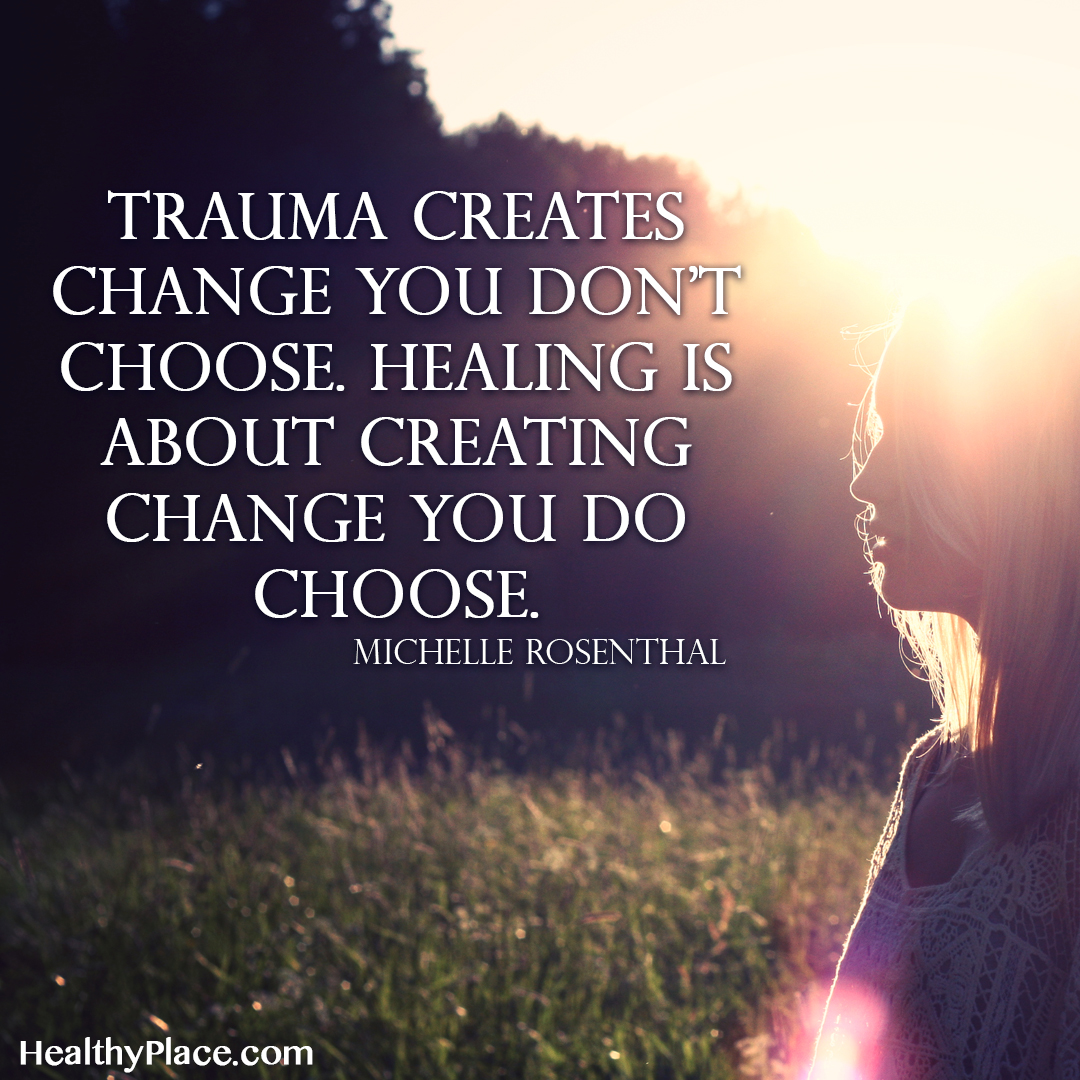
Truer words have never been spoken. I love this quote because it acknowledges the things you potentially can’t change, while redirecting you toward the things that you can.

Let’s talk about trauma. What the heck is trauma anyway? Trauma is defined as an emotional response to a terrible event. Immediately after the event, shock and denial are the most typical responses. Longer term response are more unpredictable and include mood lability, flashbacks, strained relationships and even physical symptoms like gi distress, headache, nausea and aches and pains. This sounds pretty straightforward but is actually much more subjective than you might think.

What is a terrible event? I am sure that we all have some standard ideas like natural disasters, rape, or war, but I am willing to bet that there are hundreds more, depending on the individual and the situation. It is not as black and white as it seems. Something that was pretty terrible for you may see like no big deal for someone else. To a large extent, it is a matter of perception. It is no one’s right to judge another on their response to trauma because it is impossible to truly be “in their shoes.”

So, what is post traumatic stress disorder? This is a mental health condition that is triggered by a terrifying event that is either experienced or witnessed. Symptoms include everything from nightmares, severe anxiety, flashbacks and uncontrollable ruminating thoughts about the event. It is normal to have temporary responses to trauma, but in individuals with ptsd, these responses don’t improve, often last for months or years and even disrupt daily functioning.

Well, I might as well tell you that I am having some ptsd after finishing chemo. Cancer, despite my positive attitude, still had it’s way with me mentally somewhat. It was, in fact, traumatic on multiple levels. Just like I have discussed before, I knew this was one of the risks after completing cancer treatment, not because anyone told me, but because it seemed logical. I mean, look at what my mind and my body have gone through. Chemo and the cancer itself blessed me with aches, pains, nausea, fevers, severe fatigue, neuropathy, etc and then when it was all over, my liver and kidneys took a hit and took awhile to recover….and then my thyroid died and it almost sent me into a coma….all when I was supposed to be done with all that! Mind you, I went through all of that while being off prozac so there was no mental health/anti anxiety buffer available so it was full on unrestrained feels and fear all day long. I got through it. I mean I am getting through it, but it has left some scars. Every twinge or pinch sends my brain racing with death defying possibilities if I allow it. Because, twinges or pinches meant something was terribly wrong before right? So why wouldn’t it mean that now? Oh yes, that’s right. I just had scans that were clear not even a month ago. I am ok. I saw it on film myself. Still, those rational thoughts aren’t the first ones that come to my mind when those symptoms come up.

Last night I was having a basic fibromyalgia flare, brought on by stress, like I have had a million times before, even before cancer. This time, you would have thought that I was dying. I started panicking. I decided that I wasn’t going to the party I was planning on attending. I put myself to bed and started ruminating on all the terrible possibilities until my amazing daughter pointed out that the symptoms were the same as always and she gently reminded me about the stressful day we had. Listening to her broke though my fear bubble just enough that I was able to get myself together and actually go to the party with my husband. We had a great time by the way. Thank goodness for her understanding and her voice of reason when I was being somewhat irrational. But, that’s what post traumatic stress is. It’s irrational. You sometimes cannot see your way out of it without some help.

As the quote above states, the kind of trauma that causes ptsd causes change that you don’t choose. I didn’t chose to get cancer and have organs shut down and be sick for months and months. That was a trauma and that is still affecting me. But, I can choose to continue to heal and get help for my symptoms rather than settling into them and just accepting them as if this is how the rest of my life is going to go regardless of my say so. I do have a choice! I am getting therapy. I am learning ( or trying to learn) new coping mechanisms. I am listening to my family. I am realizing that I do not have to turn in my Wonder Woman status just because I am dealing with this. I am embracing the fact that this is a battle that I do not have to fight all by myself and that is ok.

Speaking of not battling alone, I wanted to leave you with a screening guideline for PTSD from HelpGuide

Do you think you could have PTSD? Here are some screening questions. If you answer yes to three or more of these, you may also have PTSD and should seek help and therapy from a qualified mental health professional.

  1. Have you witnessed or experienced a traumatic, life-threatening event?
  2. Did this experience make you feel intensely afraid, horrified or helpless?
  3. Do you have trouble getting the event out of your mind?
  4. Do you startle more easily and feel more irritable or angry than you did before the event?
  5. Do you go out of your way to avoid activities, people, or thoughts that remind you of the event?
  6. Do you have more trouble falling asleep or concentrating than you did before the event?
  7. Have your symptoms lasted for more than a month?
  8. Is your distress making it hard for you to work or function normally?

If you answered yes to three or more of these questions, you can get help. Cognitive Behavioral Therapy can be very helpful. When you look for a therapist, make sure to look for someone that specializes in trauma and PTSD. There are also a multitude of PTSD support groups in Michigan, which is where I live. Here is some contact information.

  1. PTSD Support Group- meets in Allen Park, Mi. Hosted by Juanita Hinton 734-530-4371
  2. Trauma Recovery Empowerment Group- meets in Warren, Mi. Hosted my Tracy Denice McCall 313-635-0188
  3. Women, Trauma, and Addiction- meets in Novi, Mi. Hosted by Dr. Trisha Stock 248-721-4534
  4. ACT for Anxiety and Trauma-meets in Ann Arbor, Mi Hosted by Dr. Amy Paggeot 734-345-1356

These are just a few resources. My point is, if you think you are suffering from PTSD, don’t go through it alone. There is help out there. You may not have chosen the trauma that was inflicted on you, but you can chose not to be it’s perpetual prisoner.

Dr. Katz

The Best 35 Minutes Ever!

So, this one Saturday pre chemo I woke up feeling like a champ!  I had slept a full ten hours…..without interruption!  Holy Crap!  I didn’t even feel like I had cancer!  I had energy!  I wanted to go kick some ass somewhere!  I did a little dance.  I told everybody in the house that I was ready to go.  I sat down to breakfast 35 minutes later, smiling ear to ear.  And then, without warning, it all started melting away.  I felt the slow spread of heat and fatigue wash over me.  I started getting short of breath and achy.  I couldn’t speak in full sentences without taking a breath.  Within a few minutes, my cancer symptoms had swept back in, enveloping me in that blanket of sick that I had just swore I had shucked off for the day.  Here I was again, the lymphoma patient, set up for yet another day on the couch.  Awe man!  One of the hardest parts too is watching my husband’s temporarily hopeful facial expression slowly fade into a sad little empathetic smile that I have come to know so frequently.  This is, my friends, just the way it is.  There is a level of unpredictability about this whole thing that is never easy to reconcile, much less accept.  Welp, I guess it’s time to dig out the remote again and settle in for some more Netflix. It is what it is. That’s fine. I’ll rest for now, plotting what amazing things I could do in that next 35 minutes! This is just one of the smaller battles Cancer. You can have this one. I’m saving myself for the real one. Cue mic drop.

Dr. Katz

Does my pain have street cred even if you can’t see it?

Image result for Chronic Pain

It started off innocently enough…..some serious car accidents that I was not supposed to be able to walk away from. So, right off the top, I already know I am a blessed woman. I have not forgotten that. Then, the residual injuries slowly and insidiously crept in and invaded my bones and nerves, but that was to be expected over time. It’s not the kind of thing that you consider very much at the time because you are just lucky to be alive, right? A few aches and pains are nothing compared to losing your spot on Earth. Gotta keep it in perspective.

However, fast forward 20 years and words like stenosis and spurs and compression dominate my latest MRI. Right now as we speak, I am thanking my lucky stars that I did not have any patients today because I am having the granddaddy of all fibro flares. Being able to be at home allows me to take my Motrin, stay in my pajamas, drink a ton of water, and lay back in my ice helmet all day if I need to. I don’t have to show off my unsteady gait because of the inner ear inflammation. I don’t have to struggle just to move my arms and legs while hot pokers of pain are sticking through them as I am faking a smile. I don’t have to worry that my head and neck may blow right off my shoulders at any minute. ( Ok. Just kidding on that one. I know that is not going to happen. It just feels like it is.) I don’t have to be afraid that someone will want to show me affection with a hug that I might stiffen during, afraid to offend them because their display of kindness will only translate to pain for me. I can run to the bathroom as many times as I want with the temporary IBS symptoms that I get. Please do not misunderstand. If I had patients today, I would get myself to the hospital somehow because that is the job that I love and I would just spend the day worrying about who I let down that day anyway..lol. There is no question about it. I am just saying that I can get through this flare a little faster if I am able to concentrate at home. I consider myself lucky at this point. I am not on any chronic pain meds. That is largely because I am ferociously stubborn and the fact that I realize that, with my family history, that would potentially be a move with more risk than benefit. I still go to work. I live my life as fully as I can. I struggle but am mostly successful in maintaining an empowered attitude, which I truly feel impacts the severity of my disease. But, there are some days like this one when I need to just stop a second and breathe.

The thing is, I am not different than millions of people who are suffering from those chronic, invisible diseases every day. There are so many of them: arthritis, chronic fatigue, fibromyalgia, depression and mental illness, diabetes, digestive disorders like IBS or celiac, Lyme disease, migraines, Lupus, and Sjogrens. So, what the heck do I mean by a chronic, invisible disease? An invisible disease is one that does not show obvious external signs or symptoms. They may cause symptoms like dizziness, pain, fatigue, or mental health issues. None of these are things that a person walking by would notice. If they look ok, they must be ok, right? Wrong! Occasionally, we get excited about one of these conditions if they get featured in an article about a celebrity that was affected. But, the vast majority of the time, they go unrecognized and misunderstood by both health care providers and the general public. This really adds to the mental weight of these conditions for the patient and paves the way for feelings of isolation and hopelessness. Did you know that the U.S Department of Health and Human Services estimates that by the end of 2020, 157 million people in the United States will be affected by a chronic illness? In addition to that, the United States Census Bureau estimates that 96% of these chronic illnesses are invisible. That is a huge number! Did you also know that many studies have been done as far back as the 1990s that looked at the lack of validation( belief that the patient was really suffering) as a factor in their disease. The vast majority of patients in the focus groups said that lack of validation was their most significant challenge in managing their condition. It makes sense though, doesn’t it? We all want to be believed. When someone doesn’t believe us, it actually has the power to cause it’s own kind of pain, beside the physical pain we are already experiencing.

There are so many misconceptions about invisible chronic illness. The first one we have already discussed. A person must feel ok if they look ok. We already know that is incorrect. Most patients with these conditions have spent a great deal of time developing coping mechanisms to allow them to enjoy regular daily life. I do it every day. The second one is the conception that the person just needs to rest and they will feel better. I can tell you first hand that all the sleep in the world is not going to break or cure a fibro flare. Sometimes, you can’t even sleep because the pain gets so ridiculous. A third misconception is that all people with chronic invisible illness are really drug seekers. Labelling all of those patients as drug seekers once goes back to the lack of validation of their symptoms that I mentioned earlier. The implication that they are drug seekers indicates that their symptoms cannot be real and they cannot be in any kind of true pain. Wrong again. Another misconception that I hear is that those patients that unable to work because of their pain must “have it made” because they get to stay at home all day and goof off. I actually have heard people say this with an obvious tone of jealousy because they truly think that those homebound patients have a dreamy lifestyle, doing whatever they want all day. Let me paint you a picture: You are trapped at home, in pain, unable to work and support yourself and unable to do the things that you enjoy on a regular basis. Does that actually sound dreamy to you? I think not. Last but not least, I have heard that stress reduction is all that these patients need to get better and that their pain is “all in their head” and they need to “get over it.” Stress is definitely a factor in pain severity, as is emotion. As stress invokes emotion, pain is heightened. Emotion and perception of pain signals are biologically intertwined. However, stress does not CAUSE pain. You can be just sitting somewhere, minding your own business watching butterflies and a flare can envelop you before you know it. That kind of thinking is far too simplistic to explain chronic pain. It really boils down to another type of lack of validation.

The real question to ask is how do you support these patients, not how to cure them. There are no cures as of yet for any of the diseases that I mentioned. There may be treatments, but not cures. Many of these treatments have side effects that need to be weighed against the symptoms of the disease itself. This is important to keep in mind. So, how do you support them? You support them by listening and believing them and throwing away your preconceived biases if possible. Try not to get frustrated because you can’t cure them or that there is no obvious external marker for you to pick up on and follow. Be supportive when they need it and back off when they need space. These patients are challenging to say the least. I always use a multi-disciplinary approach that addresses the physical and the mental aspects of their condition. The team approach has worked the best in my practice. These patients are going to need pain control options, whether it be massage and acupuncture, anti-inflammatorys, Lyrica or narcotics. Their pain is real. Be ready. Most of all, you need to believe them. Sometimes the very key to their path to a reasonable quality of life may just be getting someone to listen. Have a fantastic day everyone!

Dr. Katz