The next follow up scan is less than a month away. Here comes the apparently mandatory but super unpleasant and unnecessary freaking out.

Here we go again. Another scan is coming up. How many times have I done this? well, a lot. And every single time I start to notice the feeling of unecessary fear creeping up on me. Every twinge panics me. Every tingle freaks me out. Every sense of unexpected weakness scares me.

Seriously? Enough already. I know it’s nonsense. I actually know what it is and can, if I reach back really hard to life before cancer, I can recall feeling these exact same things and they were absolutely NOTHING to worry about. How I miss those days. Granted, I do pretty well most of the time now over six months out, but those close to the next scan times are tricky. Despite all the therapy in the world and all the work put into calming, I still get nervous and icky. So, I sit myself down and purge it all out by writing to all of you. Somewhere in my head I am telling myself that I can turn my feelings and strategies into some kind of validation, encouragement or hope for those of you out there that might be in the same situation. I hear you guys. This post cancer and scan ptsd stuff is real. Make sure that you are taking care of yourself. Make sure that you are taking a step back and allowing yourself some time to acclimate. Make sure you are taking the time you need to try to heal, no matter how long it takes. There is no set timeline. Everyone is different with different levels of strength and resilience. We will all get there, to that station of calm and peace, at least sometimes. Other times, we just have to try our best. It’s all we can do.

Dr. Katz

Let’s Talk Therapy

Did you know that about 50 percent, if not more, of cancer patients/warriors/survivors have some form of ptsd? Ptsd stands for post-traumatic stress disorder. Ptsd occurs when someone has experienced or witnessed a shocking, scary, terrifying, traumatic, or dangerous event. This leads them to over respond to any sort of trauma from thereafter in an often debilitating or exaggerated way and could affect the rest of their life. It is a terrible condition. Therapy is an absolute must to try to combat this condition.

As a two-time cancer patient, I can tell ya, this crap is real. It can be devastating, debilitating and down right crappy. You find yourself freaking out at the slightest twinge, expecting the worst and not even considering the best. You have a scan coming up and find yourself grabbing for the ativan just to make it through it. It can get pretty ridiculous. Logic tells you that everything will likely be fine, but it is tough to believe it because your past experiences have taught you otherwise.

Ok, it sounds awful right? Heart pounding, sweating, pulse racing, fear coursing through your veins, ibs gettin all crazy. But, here’s the good news. There really is help out there, if you are willing to pursue it. You do not have to remain a prisoner of this terrible thing. That option is therapy. I mean actual, dig deep, deal with your demons, full disclosure psychological therapy. As difficult as it is, it can help you deal with your demons and identify your triggers and develop strategies that can either help you deal with these episodes when they happen or prevent them from happening in the first place. It’s truly a possibility of all wins.

The bottom line is that if you really want to start living after fighting your toughest enemy ever, you have to deal with the leftovers. You just have to, or else the fight won’t seem worth it in the first place.

On that note, I’m off to my regularly scheduled therapy appt. Peaceful vibes and power wishes.

Dr. Katz

I am so ready to do even more good in the world.

I have been given multiple gifts lately. I am humbled and fortunate to have survived brain cancer while breaking some records. I have returned to full functioning, besides the need for the occasional brief power nap. My memories are returning. My stamina is approaching normal levels. My business is getting back on track. All of these are such wonderful things.

Even more wonderful lately is that I have had several old acquaintances, students, etcetera reach out again for the first time in a long time. They have heard that I am healthy again and would like to get reacquainted. Some of them have stories of how they have learned from me. Some of them need my help once again. I am so blown away and honored by these remembrances. Yes 100 percent yes! Let’s reach out! Let’s reconnect! Let me help you! It would be my pleasure. I am grateful that you even thought of me. Let’s do this! I am ready to continue my outpouring of good into the world. I am ready to continue to convert my sometimes tough and traumatic experiences into good advice and support for others. I am ready!

Have an amazing and blessed day everyone!

Dr. Katz

Someday I am going to have to relearn that one twinge somewhere does not have to mean that imminent doom is upon me.

Cancer related PTSD is real people. Did you realize that one in three cancer patients suffer from cancer-related PTSD? That is over 30 percent. That is actually a huge number. First of all what is PTSD? PTSD stands for post-traumatic stress disorder. Post traumatic stress and post traumatic stress disorder are two different things. Post traumatic stress is a normal response to a stressful event. It’s like getting nervous before a scan or a blood test. Post traumatic stress disorder takes things a step further. This consists of severe stress responses to triggers that last longer than 1 to 3 months. They are responses that are so severe that they can prevent you from going to appointments or even living your life. It can be very disabling. It is nothing to be taken likely.

So, who is at risk? Everyone who has had a specific traumatic experience is at potential risk of this. Some examples would be combat, abuse, assault, violence, mental or physical disasters, severe injury, or illness, like cancer. You are also more at risk if there is any previous history of anxiety or depression or you do not have a good support system.

You have to keep in mind that there is not one single cause of PTSD. It is different in terms of triggers and severity for everybody. The symptoms can range from nightmares and flashbacks or intrusive thoughts. There can be avoidance behaviors of people, places, or things. There can be a general disinterest in participation of any kind. There can be guilt or shame about your particular trauma. There can be insomnia. There can be a feeling of general disconnect. All of these are kind of attempted internal protection mechanisms that our brains come up with. But, none of them are actually helpful.

For me, the biggest trigger is any slight hint that something could be wrong such as a pain or a headache that I cannot explain. It immediately sets my brain off to a path of potential disaster if I don’t put a stop to it right away. I mean, to be fair, it makes sense, my previous headaches and pains led to me being in an unresponsive coma with a head full of brain tumor and mush. I am right to be leery and a little hypervigilant. It is my own hyper-vigilence that has helped save my life more than once. But,I still can’t let it rule my life. I have spent enough time locked up in hospitals and struggling to get people to listen. I can take a break right now. I have fought every fight with valiance. I have all the scans and the tests that prove that I am doing ok, including a scan that looks like an actual tumor-free brain. Win! I am going to admit that it is still a work in progress. It is hard not to jump to the bad news. I am just going to keep doing my best and not beat myself up about my jumping to possible bad conclusions. It is what is is. Every day I get to wake up and see the sunshine out of the window of my own house is a blessing. I just have to keep believing that the worst of days are behind me, and get help when I need it.

Dr. Katz

It’s today it’s today.

As my lymphedema gently nudged me awake from my slumber this morning, I suddenly realized that today is a huge mental load. Today is exactly two years from the day I bolted awake with a feeling of dread, a big lump on my neck and the unconfirmed knowledge that something was horribly wrong. Even though my diagnosis was not confirmed until about two months later, that is where my journey truly started. I should have realized it was coming. On the surface, I was suppressing the memory, but my body knew better. I haven’t felt like myself in days. I had some random panic attacks. My fibromyalgia was flaring like nobody’s business and I got my first migraine in a long time. Now it all makes sense. I was refusing to acknowledge my internal ptsd out loud, but my body was doing it for me.

It occurs to me, now, two years later, that I really need to change my strategy. I have made it my mission since cancer to just keep swimming and pushing and to let nothing hold me up or get in my way anymore. I am always in motion, even if I don’t feel well. I sometimes ignore the need to take a break, because I am afraid that it will slow me down enough that I will start to dwell even more on everything that has happened to me. I also spend too much time chastizing myself for my own thoughts because I assume that my trauma clearly wasn’t as severe as a lot of other people’s.

And where is that getting me? NOWHERE! That gets me panic attacks and prolonged fibromyalgia flares and even more missed time doing what I love. I’ve got it all wrong and I need to change my strategy from constant movement to actual acknowledgement. I need to process and acknowledge/accept? what has happened. Otherwise I cannot really move forward. I read a great article in GoodTherapy magazine from May of 2011 written by Susanne Dillman, PsyD. She said that true acknowledgement of trauma is absolutely necessary for healing to begin. She points out that there is no real hierarchy of pain. Trauma is not scalable. This is a belief that is more flawed than accurate. So, me trying to downplay my trauma and compare it to others is getting me nowhere and I need to stop. She says that trauma lies at the utmost extreme of human experience and there is nothing ordinary or expected about it form the individual’s perspective. You cannot compare the danger, horror and fear involved, regardless of the content. The experience is your own. Once something is extreme, trying to rank how extreme it is is useless.

She also points out that you are literally blocking your healing journey by not acknowledging your trauma because you are denying yourself any sense of self compassion. Healing is the only way to truly detoxify trauma. I don’t think she is talking about sitting back and completely wallowing for weeks at a time. She is just saying that you need to realize that it is real and allow yourself to feel in order to get truly past it.

Dr. Katz

December 12th is coming and I’m freakin out!

Dec 12th…..Dec 12th 2020. It’s where it all started. The morning I woke up feeling like I was choking with a voice yelling inside my head to get up and look in the mirror. Whether it was my own gut instinct or my late father I will never now. That morning changed my life. I did get up. I did look into the mirror. I saw the lump on my neck and off I went. It was the beginning of a battle of fear, frustration, and anxiety as made my first steps toward my cancer revealing itself and everything that followed.

Well, that was almost two years ago. I thought I was getting better at letting it go. I really did but nope, here we are. It’s less than a month away and suddenly the panic attacks, the anxiety out of nowhere, the wondering about every little symptom is all back. It is PTSD at its best/worst. I can’t really believe how long it took me to figure it out. I guess I had to waste time beating myself up for having anxiety first. We all do. Then it hit me! Of course. The anniversary of one of the most traumatic times in my life is coming up! What normal brain can completely let that go? That trauma gets stored and buried, with significant effort from me. But, even I can’t hold it back all the time. Lord knows I try.

So, what do I do? I can’t keep fighting to suppress it. That will only keep me prisoner to it longer. I have to acknowledge it! I have to embrace that it is real and that it happened and that it affected me in ways that I still don’t fully process. I have to actualize my own feelings about it. The only way to be free is to go forward through it when the feelings flood me. The only power I have is the power to see it for what it is and decide how I want to proceed. The choice of direction is actually completely up to me. I could allow a day( or two or three) to break down and crumble. I could stop functioning. Or, I could move forward and use the experience for good. They say that the final stage of healing occurs when you are able to use what happened to you to help others. That is what I have chosen and continue to chose. I have written my books. I am giving my talks. I am helping other cancer patients. I help other people “get their mind right” for the battle ahead. I share knowledge every day to help give people some sense of control as to what is happening to them. These are the battles I chose to fight every day. These are the battles I want to win. I realize that my past trauma is still with me. I cannot change that, but I can chose to change what I do with it.

Dr. Katz

Hiya PTSD! How you doin?

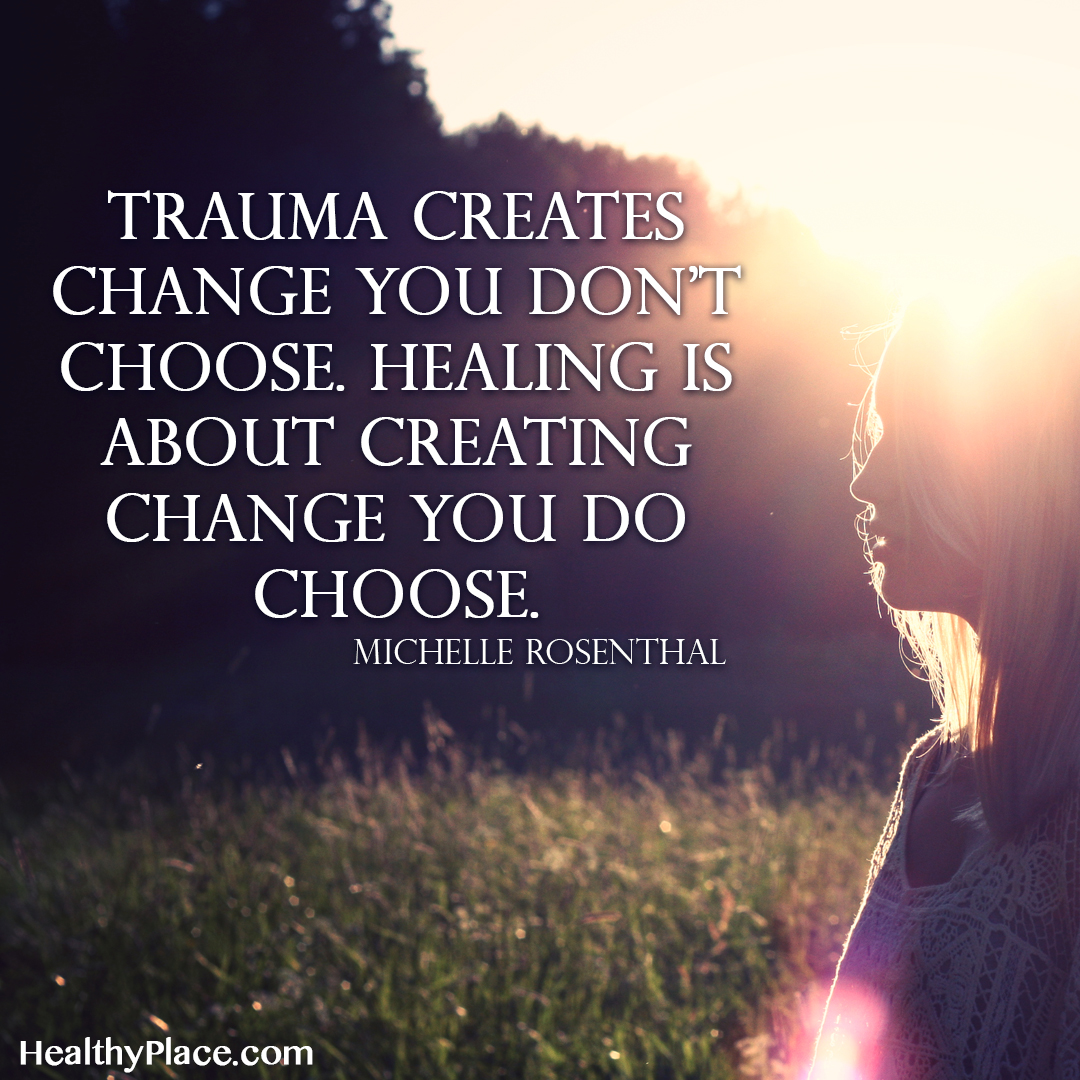
Truer words have never been spoken. I love this quote because it acknowledges the things you potentially can’t change, while redirecting you toward the things that you can.

Let’s talk about trauma. What the heck is trauma anyway? Trauma is defined as an emotional response to a terrible event. Immediately after the event, shock and denial are the most typical responses. Longer term response are more unpredictable and include mood lability, flashbacks, strained relationships and even physical symptoms like gi distress, headache, nausea and aches and pains. This sounds pretty straightforward but is actually much more subjective than you might think.

What is a terrible event? I am sure that we all have some standard ideas like natural disasters, rape, or war, but I am willing to bet that there are hundreds more, depending on the individual and the situation. It is not as black and white as it seems. Something that was pretty terrible for you may see like no big deal for someone else. To a large extent, it is a matter of perception. It is no one’s right to judge another on their response to trauma because it is impossible to truly be “in their shoes.”

So, what is post traumatic stress disorder? This is a mental health condition that is triggered by a terrifying event that is either experienced or witnessed. Symptoms include everything from nightmares, severe anxiety, flashbacks and uncontrollable ruminating thoughts about the event. It is normal to have temporary responses to trauma, but in individuals with ptsd, these responses don’t improve, often last for months or years and even disrupt daily functioning.

Well, I might as well tell you that I am having some ptsd after finishing chemo. Cancer, despite my positive attitude, still had it’s way with me mentally somewhat. It was, in fact, traumatic on multiple levels. Just like I have discussed before, I knew this was one of the risks after completing cancer treatment, not because anyone told me, but because it seemed logical. I mean, look at what my mind and my body have gone through. Chemo and the cancer itself blessed me with aches, pains, nausea, fevers, severe fatigue, neuropathy, etc and then when it was all over, my liver and kidneys took a hit and took awhile to recover….and then my thyroid died and it almost sent me into a coma….all when I was supposed to be done with all that! Mind you, I went through all of that while being off prozac so there was no mental health/anti anxiety buffer available so it was full on unrestrained feels and fear all day long. I got through it. I mean I am getting through it, but it has left some scars. Every twinge or pinch sends my brain racing with death defying possibilities if I allow it. Because, twinges or pinches meant something was terribly wrong before right? So why wouldn’t it mean that now? Oh yes, that’s right. I just had scans that were clear not even a month ago. I am ok. I saw it on film myself. Still, those rational thoughts aren’t the first ones that come to my mind when those symptoms come up.

Last night I was having a basic fibromyalgia flare, brought on by stress, like I have had a million times before, even before cancer. This time, you would have thought that I was dying. I started panicking. I decided that I wasn’t going to the party I was planning on attending. I put myself to bed and started ruminating on all the terrible possibilities until my amazing daughter pointed out that the symptoms were the same as always and she gently reminded me about the stressful day we had. Listening to her broke though my fear bubble just enough that I was able to get myself together and actually go to the party with my husband. We had a great time by the way. Thank goodness for her understanding and her voice of reason when I was being somewhat irrational. But, that’s what post traumatic stress is. It’s irrational. You sometimes cannot see your way out of it without some help.

As the quote above states, the kind of trauma that causes ptsd causes change that you don’t choose. I didn’t chose to get cancer and have organs shut down and be sick for months and months. That was a trauma and that is still affecting me. But, I can choose to continue to heal and get help for my symptoms rather than settling into them and just accepting them as if this is how the rest of my life is going to go regardless of my say so. I do have a choice! I am getting therapy. I am learning ( or trying to learn) new coping mechanisms. I am listening to my family. I am realizing that I do not have to turn in my Wonder Woman status just because I am dealing with this. I am embracing the fact that this is a battle that I do not have to fight all by myself and that is ok.

Speaking of not battling alone, I wanted to leave you with a screening guideline for PTSD from HelpGuide

Do you think you could have PTSD? Here are some screening questions. If you answer yes to three or more of these, you may also have PTSD and should seek help and therapy from a qualified mental health professional.

  1. Have you witnessed or experienced a traumatic, life-threatening event?
  2. Did this experience make you feel intensely afraid, horrified or helpless?
  3. Do you have trouble getting the event out of your mind?
  4. Do you startle more easily and feel more irritable or angry than you did before the event?
  5. Do you go out of your way to avoid activities, people, or thoughts that remind you of the event?
  6. Do you have more trouble falling asleep or concentrating than you did before the event?
  7. Have your symptoms lasted for more than a month?
  8. Is your distress making it hard for you to work or function normally?

If you answered yes to three or more of these questions, you can get help. Cognitive Behavioral Therapy can be very helpful. When you look for a therapist, make sure to look for someone that specializes in trauma and PTSD. There are also a multitude of PTSD support groups in Michigan, which is where I live. Here is some contact information.

  1. PTSD Support Group- meets in Allen Park, Mi. Hosted by Juanita Hinton 734-530-4371
  2. Trauma Recovery Empowerment Group- meets in Warren, Mi. Hosted my Tracy Denice McCall 313-635-0188
  3. Women, Trauma, and Addiction- meets in Novi, Mi. Hosted by Dr. Trisha Stock 248-721-4534
  4. ACT for Anxiety and Trauma-meets in Ann Arbor, Mi Hosted by Dr. Amy Paggeot 734-345-1356

These are just a few resources. My point is, if you think you are suffering from PTSD, don’t go through it alone. There is help out there. You may not have chosen the trauma that was inflicted on you, but you can chose not to be it’s perpetual prisoner.

Dr. Katz